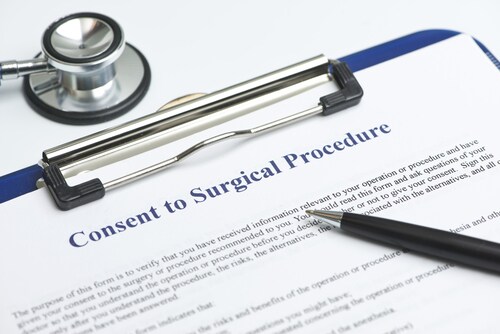
When a surgeon is sued by a dissatisfied patient for battery or harm, this litigation often revolves around the informed consent process. To wit:
- “My surgeon never told me that my filler injection could cause blindness…if he had, I never would have consented.”
- “My surgeon told me he might have to remove my nasal turbinates to restore my breathing, but never mentioned there was a small chance this could backfire and result in even worse breathing problems.”
- “I only authorized liposuction on my love handles, but during surgery, my doctor also performed lipo on my inner thighs.”
How is it possible for a patient and their surgeon to have such different understandings? Let’s look at it from both sides.
From the surgeon’s perspective. During pre-operative consultations, patients can be indecisive about the options offered by their surgeons, sometimes even vacillating or putting off final decisions until the day of surgery. If a patient insists at the last minute that a procedure be done or not done, sometimes consent forms aren’t updated. Other times, the patient has already been given a sedative and might not remember the conversation. Also, during surgery, a surgeon may find an urgent reason to perform an unconsented procedure — a situation that is permissible under law.
From the patient’s perspective. Surgeons often rush through the informed consent discussion as if giving a 30-second speech. In my experience, surgeons rarely cover all the potential complications that are listed in the fine print on their consent forms. Instead, they might boast that their complication rates are vanishingly small, then hand you a consent form with a long list of very serious potential risks related to your procedure(s). If any of this happens to you, ask your surgeon to slow down so that everything is explained to you clearly and slowly in terms you can understand.
During pre-operative consultations, some surgeons pressure patients to perform additional elective procedures without properly disclosing risks. In cosmetic surgery, some practitioners might be so enamored by their own aesthetic sensibilities that they decide to take a different approach while you’re asleep on the table, believing you’ll be pleased once you wake up. The most deplorable surgeons might even forge your consent during surgery or after the fact.
The purpose of obtaining informed consent is for the patient to make an informed decision, to prevent surprise to the patient and, at the same time, to protect the physician from a potential lawsuit for damages if a risk or complication manifests itself as a result of the procedure.
Carolyn Oill, Esq.
I’m going to describe how informed consent should work in a patient-centered care context, give you examples of how misunderstandings can arise (especially in elective same day surgery), then explain how patients can ensure they are in lockstep with their surgeons.
The Informed Consent Process
Surgical consent is not an event or a signature on a form, but a process of shared decision making between patient and surgeon in which the parties build trust and exchange views. During this process, the surgeon must provide sufficient information for the patient to make an informed decision about what is to be done to their bodies.
This means the surgeon has to explain diagnoses, treatment alternatives, expected outcomes, and potential risks and complications — as well as the risks and benefits of doing nothing. To help the patient decide on whether to proceed, the surgeon must also describe the short- and long-term recovery process. Discussions like these help the patient develop realistic expectations. Throughout, the surgeon needs to encourage questions, avoid clinical terminology as much as possible, and carefully explain clinical words and concepts.
Sometimes, the surgeon won’t be able to provide a definitive treatment plan beforehand, as a diagnosis cannot be made until surgery is underway. (For example, if a patient presents with breathing problems, a plastic surgeon might first have to open the nose to pinpoint the cause of the blockage, whereas an ENT surgeon might use imaging to diagnose the cause beforehand.) In such cases the surgeon needs to explain how, during your operation, s/he will make the decision about how to proceed. Most obviously, it’s crucial that the patient understand the range of possible surgical approaches.
“Consent is an opportunity to guide the patient to the right decision for them, and also dispel any unrealistic expectations concerning the procedure. Ultimately it is an opportunity to create a relationship of openness and trust between doctor and patient, which may help if operative complications are encountered.”
Anderson OA, Wearne IM. Informed consent for elective surgery–what is best practice? J R Soc Med. 2007;100(2):97-100. (link)
The Informed Consent Form
The informed consent process culminates the patient’s signature in a form that memorializes their mutual understanding with the surgeon. Valid consent requires the patient be competent to make such a decision, understand their treatment options and the risks and benefits of each, and not be acting under duress.1,2
The specific wording on consent forms varies from state to state and may also depend on the agency that accredits the surgical facility in which the procedure will be undertaken.
“Unfortunately, the emphasis on obtaining a patient’s signature as documentation of informed consent results in varying effectiveness of the communication between a clinician and a patient.”
The Joint Commission (April 2022). Informed consent: More than getting a signature. (link)
Patients should take the time to read the entire consent form in an unhurried fashion and be encouraged to ask any final questions that may arise. Ideally, the surgeon will be present during the signing so the patient feels welcome to explore any remaining uncertainties they may have.
When Informed Consent Goes Off the Rails
According to The Joint Commission, a standards-setting and accreditation body, problems that contribute to misunderstandings during the consent process include3:
- Failure of providers to assess the health literacy of the patient and adjust their consent process to account for this.
- Poor provider-patient communication and lack of shared decision making during the process.
- Missing information on consent forms. (In one study, only one-quarter of consent forms included all the relevant elements of informed consent – nature of the procedure, risks, benefits and alternatives.4)
In my over 25 years assisting in surgery and supporting patients before and after, I’ve seen errors in each of these areas. For instance, when the consent form is completed on the day or surgery the risk of a misunderstanding increases, as some patients may develop doubts as they read through their form but feel pressure to sign it anyway. This is especially true if the surgical team is waiting for the patient to be wheeled into the operating room. Sadly, I have seen many consent forms signed after a sedative or sleep-inducing medication was administered.
Especially with cosmetic procedures, I’ve also seen patients make changes or additions to their surgical plans on the morning of surgery, during their final consultation with the surgeon. This obviously doesn’t give the patient much time to reflect on their decision. Moreover, rushed additions or corrections to the consent form might not be properly dated, time stamped, and signed by both parties.
Then there’s the question of how much information to share with patients during the process, especially concerning potential surgical complications. Too little information fails to inform, while too much information may cause undue worry. Should the consent form list every possible complication, even minor ones with extremely low probabilities that the surgeon did not even bring up during pre-op discussions? In my experience most consent forms include long lists of complications that are never discussed with patients beforehand, or are couched in language that’s too technical or lacks specificity. These are bad practices. Also, if a surgeon asks you to sign additional forms describing risks and complications, please take a pause, as this is not standard practice. Your official consent form should describe all consequential risks, making supplemental forms unnecessary.
Let’s go back to the example patient presenting with breathing problems. Assuming the surgeon might have to reduce or even remove nasal tissues that warm and moisten air flow (called turbinates), should the patient be warned that this might result in permanent disability from a rare and life-changing complication colloquially called Empty Nose Syndrome? This is a tough call. If the surgeon describes this risk as potentially resulting in a “permanently impaired nasal airway,” this description might meet the letter of the law, but it doesn’t convey the nature of this rare complication in terms a lay person can understand. It’s more helpful to explain how a major complication might affect the patient in the future (e.g., permanent feeling of nasal blockage and excessive nasal mucus, permanently worse vision or even blind eye, etc.).
It’s always a good idea for the surgeon to assess the patient’s level of understanding before the consent form is signed. The best way to do this is for the surgeon ask the patient to repeat back his or her understanding of the information the surgeon has communicated. This will increase the likelihood that the surgeon has effectively managed the patient’s expectations.
“Informed consent for elective surgery is often obtained by junior medical staff…(who might not) have not received specialist training in advising patients about the procedure.”
Journal of the Royal Society of Medicine (2007 Feb). Informed consent for elective surgery — what is best practice? (link)
Of course, at any point in the process, if the surgeon or a staff member doing patient intake feels the patient’s questions reflect a lack of understanding about the procedure, then the process must slow down so that the two parties can first get on the same page.
How Surgeons and Patients Can Avoid Misunderstandings
Here are some simple steps surgeons and patients can take to solidify the consent process. In the hectic run-up to surgery, I’ve seen both patients and even experienced surgeons neglect crucial aspects of this process. In most cases, everything goes smoothly, and these oversights don’t have negative consequences. But not always.
Surgeons can mitigate their potential risks by:
- Making sure they describe major risk factors in in layman’s terms (both verbally and in writing on the form), preferably by describing how various complications might affect the patient in the future.
- Asking their patients to repeat back their understandings of what is to be done in surgery, and potential adverse outcomes.
- Being available for last minute questions when patient read and sign their consent forms.
- Ensuring that any same-day changes are carefully explained, documented, and signed by the patient before they are prepped for surgery.
- Videotaping their consent discussions with patients.
As for patients, you need to:
- Ask questions at every step of the process, especially about risks and complications.
- If your form includes a long list of risks that haven’t been previously discussed, ask your surgeon to explain each one before signing.
- Make sure that any additions or corrections to your consent form are dated, timed, and signed by both parties.
- Avoid signing your consent form the day of your procedure.
- For your protection, snap a photo of the fully executed consent form just before your surgery, or request a photocopy. (Otherwise, since most forms are paper-based, if something goes badly wrong, a dishonest surgeon might forge and back-date your consent form to cover up a poor surgical decision or technique.)
- Insist on having an interpreter when necessary for your informed consent discussion.
Of course, the vast majority of surgeries are properly consented. Still, as I often counsel readers at the end of my posts, “trust but verify,” and “you can never be too careful.”
Nothing in this article should be relied on for medical or legal advice.
FYI, I wrote a shorter, companion post about surgical consent that you can find here.
Footnotes
1 Anderson OA, Wearne IM. Informed consent for elective surgery–what is best practice? J R Soc Med. 2007;100(2):97-100. doi:10.1177/014107680710000226 (link)
2 Bernat JL, Peterson LM. Patient-Centered Informed Consent in Surgical Practice. Arch Surg. 2006;141(1):86–92. doi:10.1001/archsurg.141.1.86 (link)
3 The Joint Commission (April 2022). Informed consent: More than getting a signature. (link)
4 Bottrell MM, et al. Hospital informed consent for procedure forms: Facilitating quality patient-physician interaction. Archives of Surgery. January 2000;Vol. 135. (link)
Copyright © 2025 by Monica Berlin
 BerlinWrites