
State medical boards are agencies that license medical doctors, investigate complaints, discipline physicians who violate the medical practice act, and refer physicians for rehabilitation when appropriate. If you’ve been injured by a licensed medical doctor, perhaps you’ve considered filing a medical board complaint to seek disciplinary action. The right to practice medicine is a privilege granted by states, and medical boards regulate this practice.
However, you should know that medical boards are funded by fees paid by physicians themselves, and their governance and procedures are heavily influenced by powerful physician lobbyists. Patient advocacy groups have long criticized state-level medical boards for being lax in disciplining doctors, complaining of regulatory capture — the process by which regulatory agencies can become guided by the interests they regulate instead of serving the public interest.
Something fishy is clearly going on with state-level medical boards, as demonstrated by a Public Citizen analysis of state-by-state disciplinary actions taken per 1,000 licensed physicians summarized in the chart below.1 How is it that the rate of serious disciplinary actions can vary so widely, from a high of almost 1.8% in Michigan, to 0.2% in Georgia?
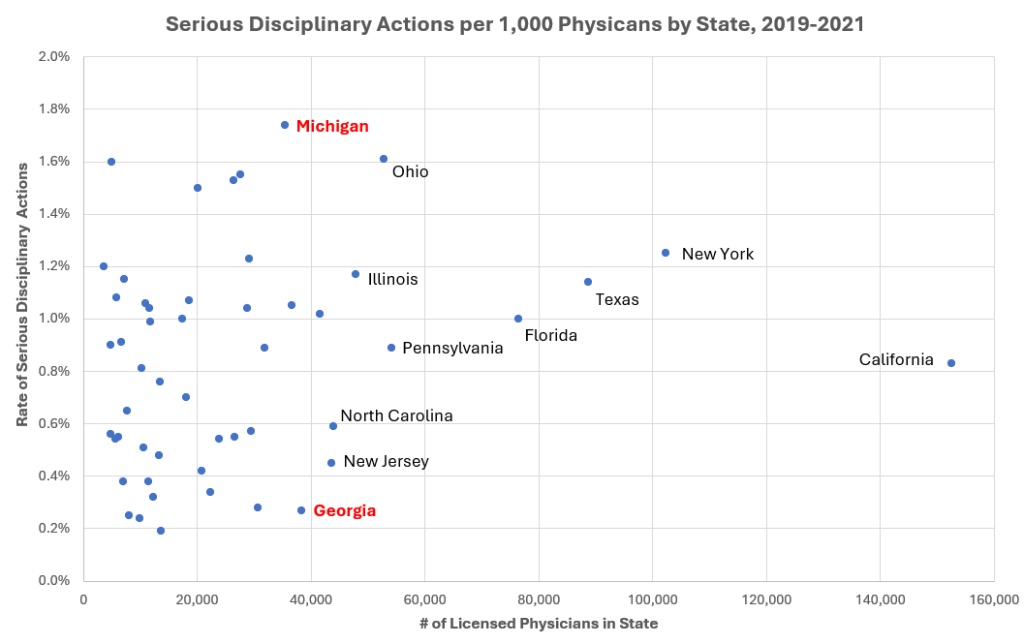
This nine-fold difference between Michigan and Georgia cannot be explained away by anything other than regulatory capture. Do you really believe that Michigan’s doctors are nine times more error prone than Georgia’s, or that patients injured in Georgia are nine times less motivated to file medical board complaints?
Some states are trying to address the regulatory capture problem. For example, in 2023, after a flurry of Los Angeles Times investigations into doctors that were allowed to continue practicing despite indisputable negligence, the California legislature enacted a series of reforms to address lax Medical Board enforcement. Their reforms included lowering the standard of proof required to initiate a disciplinary action, changing the composition of the governing board, and requiring the board to interview every complainant. 2,3
In their report, Public Citizen concluded that “many if not most state medical boards are doing a dangerously lax job in enforcing their states’ medical practice acts.”
“Many if not most state medical boards are doing a dangerously lax job in enforcing their states’ medical practice acts.”
Public Citizen (link)
What does all of this mean for you? If you’ve been harmed by negligent care and you have a clear-cut case with substantial evidence, of course you should consider filing a complaint with your state medical board. Any doctor who causes harm or injury, delays treatment, or otherwise provides substandard care is subject to a formal complaint. But if you’re in a state where your medical board is tilted in favor of the powerful physicians’ lobby, you will have to be a bulldog in working with your assigned medical board investigator to make forward progress. Educate yourself about your state board’s procedures, and if you feel as though your investigator is not doing their job, reach out to your local state senator or representative for additional muscle.
If you’re as disappointed as I am about all of this, please contact your state senators and representatives, and re-post this piece to your social media feeds.
Nothing in this post should be relied on for legal or medical advice.
Footnotes
1 No author (2021, 31 March). New Public Citizen Analysis Finds Major Differences Among States in Rates of Serious Physician Disciplinary Actions. (link)
2 Dolan, Jack and Christensen, Kim (2021, 14 July). Botched surgeries and death: How the California Medical Board keeps negligent doctors in business. Los Angeles Times. (link)
4 Villanueva, Gabriela (2023, 12 July). Proposed Changes Coming to the Medical Board of California. (link)
Copyright © 2025 by Monica Berlin
 BerlinWrites